Field Technician Accelerated AI Training
Aspen AI - Contract
Overview
This project reimagined a field technician training program that relied on dense, text-heavy materials and took new hires close to a year to complete. Working within the client's existing LMS, I designed a trainee learning experience that used AI to transform complex technical documentation into multimodal training content. The result: a concept-level LMS demo proving that complex material could be delivered faster while improving engagement and comprehension for new technicians.
Tools
Figma
FigJam
ChatGPT
Gemini
NotebookLM
Gamma AI
Timeline
Jun - Nov 2025
Role
UX Designer
Team
Collaborative team project. Owned the trainee learning experience flow, AI-assisted content generation, and LMS demo mockups.
The Problem
The client's existing training experience created real friction for new technicians:
Onboarding programs took close to a year to complete.
LMS modules were repurposed directly from training manuals and PowerPoint decks.
Content was repetitive, text-heavy, and cognitively overwhelming.
Converting large technical documents into LMS-ready content was slow and resource-intensive.
Training lacked multimodal formats to support varied learning styles.
Design Focus
Rather than redesigning the LMS interface, this project centered on improving learning clarity and content efficiency within existing platform constraints.
Primary Goals:
Reduce cognitive overload in technical training content.
Introduce multimodal learning formats (read, listen, interact).
Demonstrate how AI could accelerate instructional content creation and structuring.
Maintain full compatibility with the client's current LMS.
My Role & Contribution
As UX Designer, I shaped how trainees would experience and progress through the training content.
Key Deliverables & Actions:
Designed a trainee learning experience flow to guide module progression.
Applied AI to summarize and restructure large technical documents into digestible content.
Directed AI-assisted instructional content and imagery generation.
Built a high-fidelity Figma LMS demo for stakeholder presentation.
Mapped end-to-end user flows across eight training modules from Scope/Module Overview and Pre-Inspection Setup through Inspection Procedure, Defect Marking & Notes, Report Generation, and Review & Certification Prep, to Hands-On Exercises and Knowledge Checks.
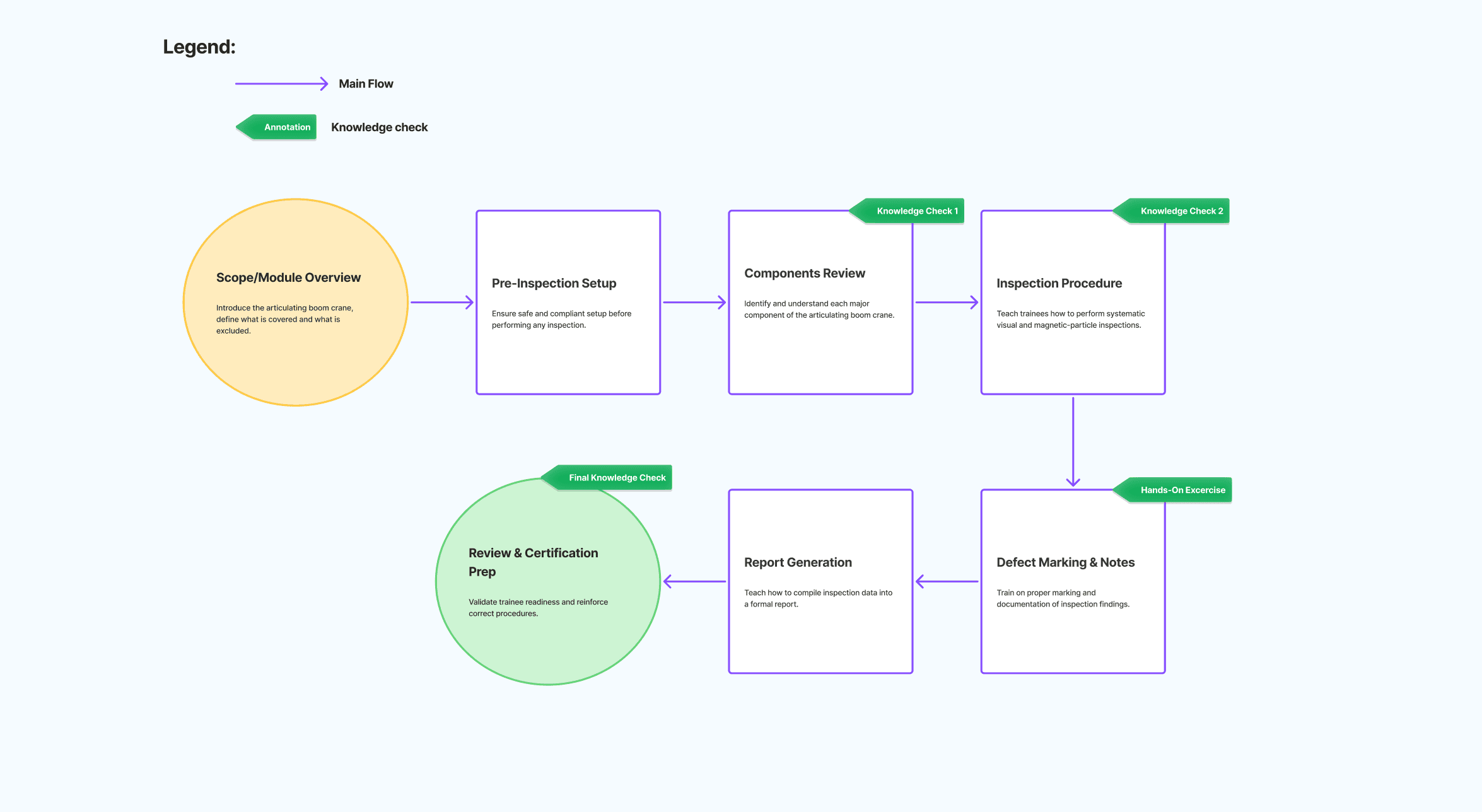
User flow showing how trainees move through structured, AI-assisted training modules, from introduction to assessment
Solution Overview
The final concept demo showed how AI-generated content could power a more engaging, structured learning experience, including:
Chapter summaries that broke down complex material into digestible sections.
Podcast-style audio for alternative, on-the-go learning.
AI-generated instructional imagery (e.g., a Scope & Standards Overview for Articulating Boom Cranes referencing CSA Z150.3 and ASME B30.22 standards).
Interactive hover states (e.g., hovering over hydraulic extensions to reveal contextual detail).
Drag-and-drop activities for identifying and placing key components (Outriggers, Pedestal Turret, Main Frame, Swivel Load Hook, and more).
Embedded knowledge checks to reinforce comprehension.
Note: Due to a signed NDA, detailed mockups, prototypes, and additional artifacts cannot be shared publicly. Visuals shown here are limited and approved for portfolio use.
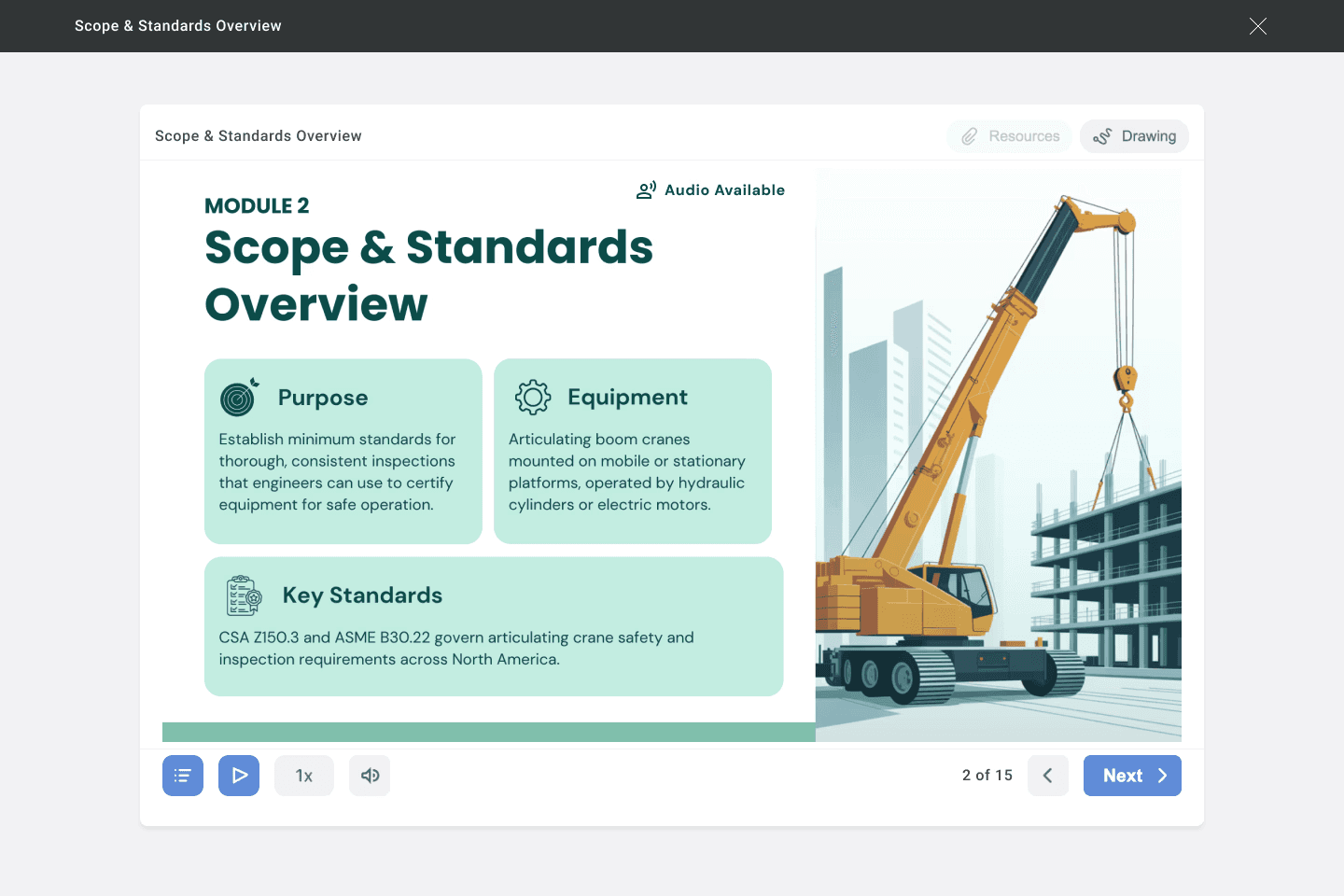
Scope and standards overview outlining key requirements and guidelines for the training module
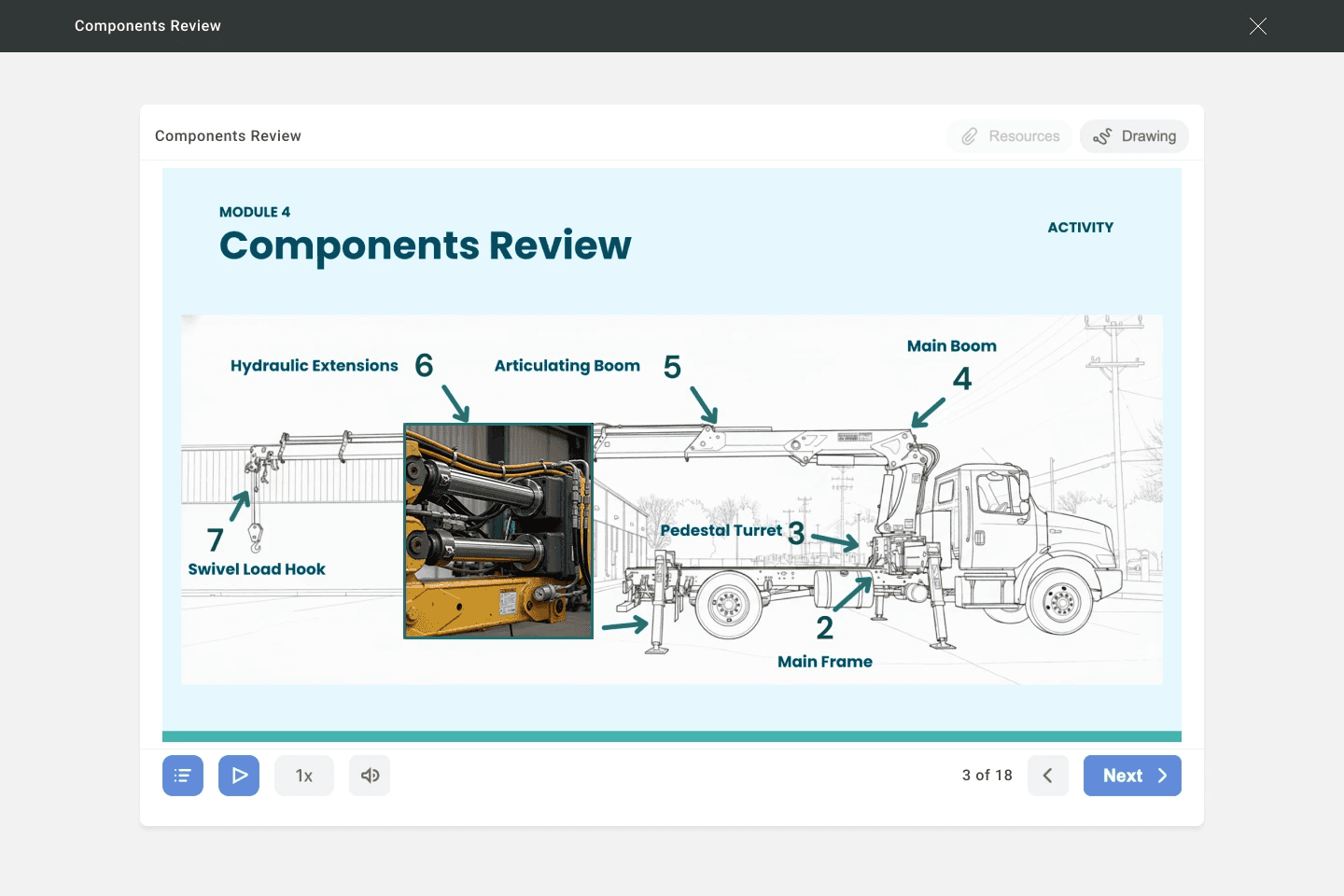
Hover interaction revealing an AI-generated image to provide visual context for a hydraulic extension
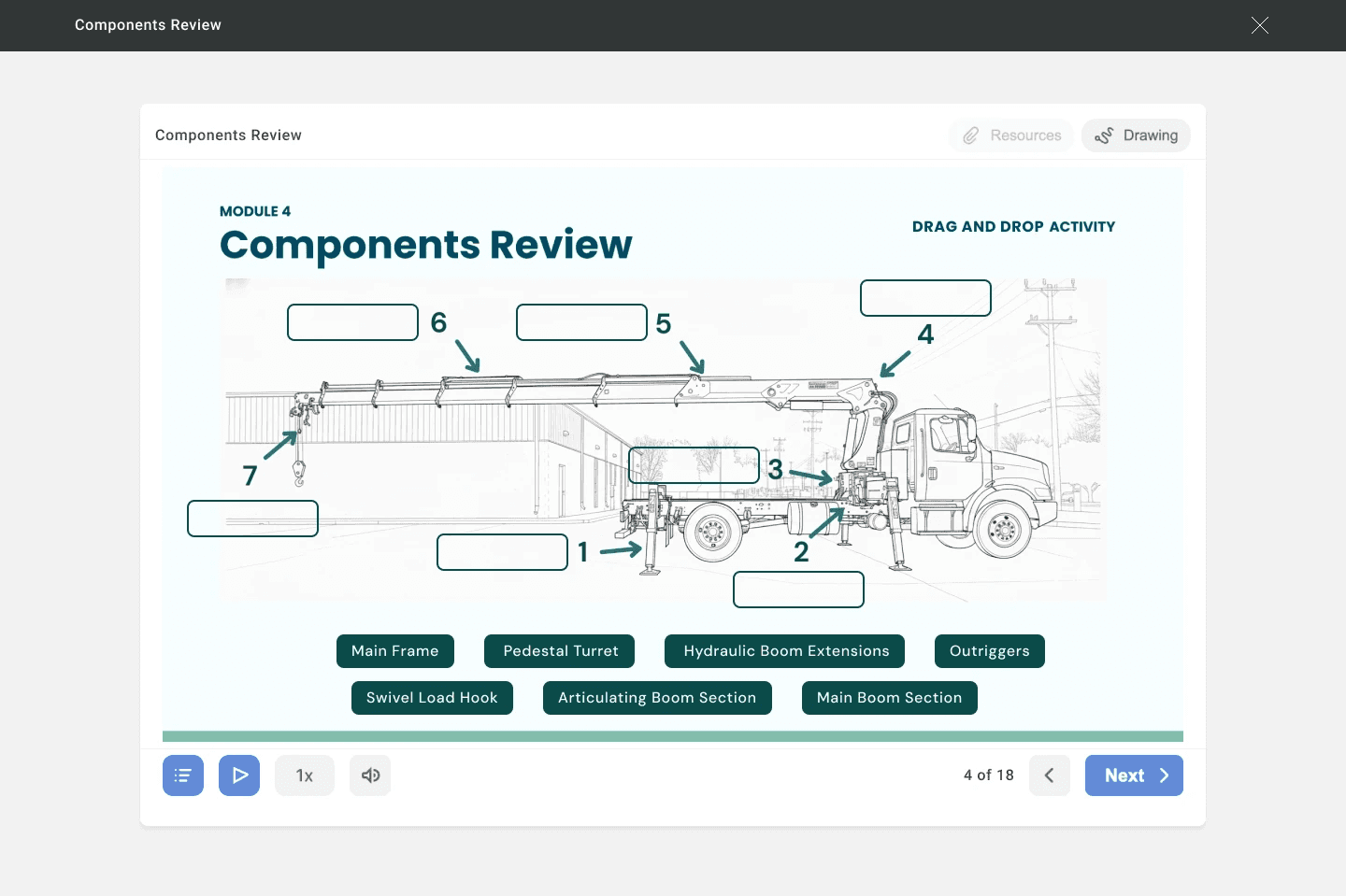
Drag-and-drop activity designed to help trainees identify and place key components correctly
Constraints & Real-World Considerations
Platform limitations tied to the client's existing LMS.
Highly technical content requiring careful AI-output review for accuracy.
A two-week delivery window for stakeholder presentation.
Delays in receiving training materials and LMS access.
Navigating the introduction of AI-generated content into an established workflow.-
Outcomes
Presented the concept demo directly to stakeholders, including the CEO, who responded positively, expressing enthusiasm for AI's potential role in future training initiatives.
Validated, at the concept level, that AI-generated content could make technical training clearer and more engaging, setting the direction for future development.
Confirmed leadership buy-in to explore AI-supported training in a future phase.
Delivered Phase 1 concept work on time, within a two-week presentation window.
Note: This project is currently in early development; the AI-assisted LMS tool has not yet been built or deployed. This case study reflects concept and design work only.
Lessons Learned
AI accelerates content creation, but UX judgment remains essential for accuracy and usability.
Clear stakeholder communication is critical when introducing AI into established workflows.
Designing within tight constraints sharpened focus on the core learning experience.
Next time, I'd push earlier for training materials and platform access to allow more iteration time.